The joy of cultural differences
The last year in Canada has been a year of many different cultural firs timers for us. At times, we have felt silly not knowing stuff, seeing stuff that was totally new for us or things that were just done in a totally different way. Last weekend I attended the Graduation Ceremony of Sir John Franklin High School, and yes, all the things they seem to do in the movie (throwing hats, etc), they really did it!
One a few occasions, we were able to show a few Dutch cultural aspects to inhabitants of Yellowknife as well, especially when it came to cooking, which is of course easily shared and enjoyed, as we did with Canadian foods ourselves as well. Think about the numerous occasions we enjoyed game, but also curries, Canadian style breakfast and tons of stuff I forget to mention now. When it came to sharing Dutch food, we did quite a few things as well: we made speculaas (a cookie) and a fusion of semi freddo (italian desert) with speculaas. We made “Knorr Wereldgerechten” (Hamburger Helper 75.0) , “stamppot boerenkool” (cale with mashed potatoes and bacon), “hutspot” (mashed potatoes with mashed carrots, meat and onions) and probably more dishes I am forgetting.
But all that is nothing compared to the adventure on which we embark tomorrow. One of the most typical Dutch things – besides saying about too many things they are typically Dutch (especially when they are not) – so far: “gourmetten”, which we’ll from now on call “Dutch raclette”, until a better word or description is found. Join me on an adventure to explain this wondrous activity to them who are unaware of this marvellous display of grandeur: a way to incorporate good food, good friend, good wine and / or good {fill in your own option}, all together in one evening. (Yes I will tone it down from now on 😉 )
Origin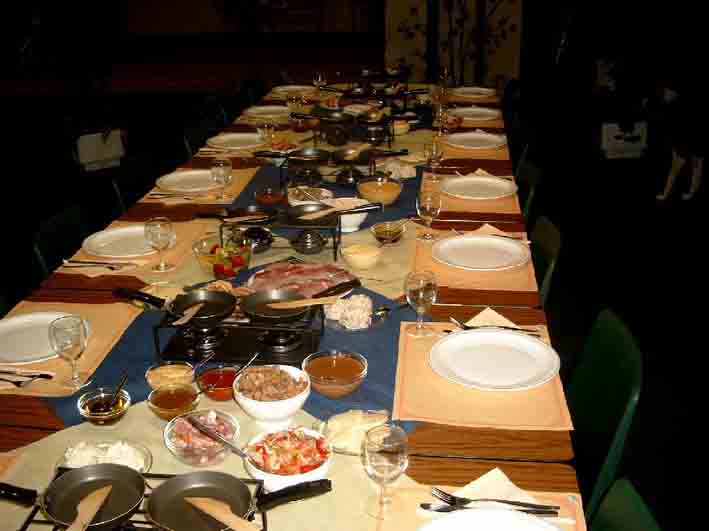
It seems everybody here thinks raclette is a solely Swiss activity. We bought friends of ours a Raclette set and at that time we were a bit surprised with the Swiss flag on the box. We thought it was just Swiss made and quite a few of the things that are made in Switzerland are of a excellent quality, so seeing that Swiss flag made us happy. But as we know now, the English speaking world seems to be only aware of the Swiss way of raclette. Just blame it on a misplaced arrogance, another Dutch quality.
Of course in The Netherlands we are aware of the fact the Swiss are doing something very simular to our national christmas tradition, that incorporates a lot of cheese. I am pretty sure we have people enjoying a Swiss raclette every now and then in The Netherlands, but unlike the Swiss Raclette the tradition of Dutch raclette is widely spread in our country. As is the tradition to do this with Christmas and / or Easter. For those who think we took it from the Swiss, think again, it is more likely the Dutch raclette is based on the stir frying the world took from Asia, in our countries scenario especially from Indonesia, that was a Dutch colony for a long time. A miniscule amount of information about what Dutch raclette is can be found here. (Go to “Special Occasions”, read the third alinea)
But what does this wondrous event look like? How will I recognize it?
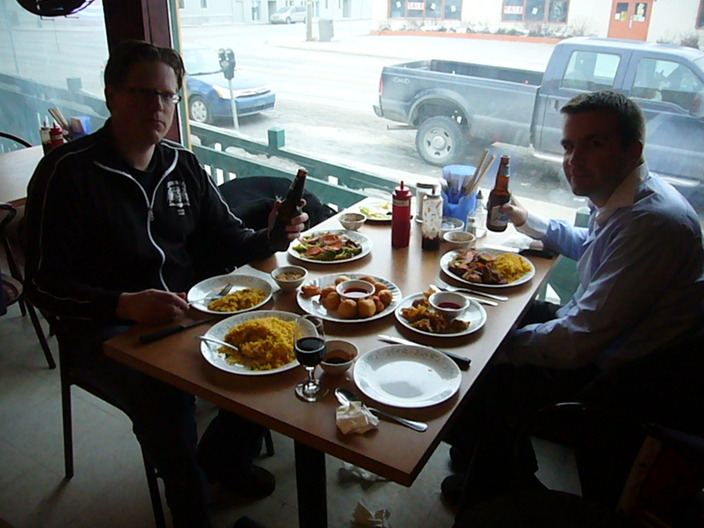
Well, a table set for Dutch raclette will be loaded. It will look like a bombardment of food, divided over little bowls, small plates and one, or in case it is a large table, more than 1, huge (and I mean HUGE) plate of meat. (See picture on the right and the one above) Seafood is making its way to the Dutch raclette table more and more, but usually you will find it on one of the smaller plates. There will be veggies, and like the seafood and the meat, all those items will be cut to bite size pieces that fill up 1/4 to 1/2 of a skillet, which is found on the raclette set, or sitting on or by your plate. Besided cutlery you will find a little (often wooden) spatula to stir in your skillet.
Next to all the food which is intended to visit your skillet before ending on your plate and in your stomach there will be a lot of food that accompanies it. Bread, salads, sauces like aïoli, garlic sauce, barbeque sauce, the indosian peanut sauce and more. Dutch people like sauces a lot and compared to the sauces on the North American continent, they are generally sweeter because they lack vinegar. Just to give some ideas, look here, here and here.
So what does one do when on is participating in a Dutch raclette?
Well, there are some differences in The Netherlands when it comes to the way the cooking is executed.
- Some people will use the top of the raclette set to cook meat, fish and vegetables. The skillets will only be used to bake pancakes, eggs, potatoes and such on the lower level of the raclette. Note that this is not possible when using the old-fashioned raclette sets with skillets each over their own (little) open flame, that is fed by spiritus or another oil.
- Other people will cook everything in the skillets, using the top as a spot to place their skillet on.
Most commonly it seems families have a simular way of cooking on a raclette set. Both Judiths and my family opt for version 2. It takes longer, so Dutch raclette in our family really is an event that is done to enjoy the company of family and / or friends, rather than just shoving your food in like a lumberjack. The entire process is enjoyed, over and over again. A skillet will be filled over and over again, each time only producing a mouth full of food.
 Generally, the following steps will be executed:
- put a bit of butter (with or without herbs) or oil in our skillet
- place a piece of meat in your skillet
- according to your estimate of time it will take to cook the meat, place vegetables in the skillet or
- wait until meat is almost cooked and place vegetables in pan to cook shortly until done as well
- Remember to use a seperate utensil for raw meat and only use your wooden or plastic spatula for the skillet, since it will be a nonstick pan 90% of the cases
- Take meat and if present vegetables out of skillet and repeat process
Variations
First of all, raclette sets can be found in many different variations. Some will be intended to be used by one person, some by two, four, six or even eight people. Some are square, some rectangular, some round, some oval. Some people buy pre-made sauces and pre-cut meat, some people make home made sauces, cut their own meat, marinate meat, and there are a lot of fusions with different kitchens from all over the world and Dutch raclette. Mediterranean tapas can be finished in the skillet, one can stir fry, pancakes can be baked, shoarma can be enjoyed when put on the lower level of the raclette set for a few minutes. Whateveryou come up with, downsize it and it can be brought to the Dutch raclette. Allthough it proved to be hard to find good results with google, there are some websites with nice recipes and explanations.
Conclusion
A lot more can be said about Dutch raclette, but I’ll leave it at this for now. Judith and I were surprised it was seems to be pretty unknown here. Oh well, I’ll guess we’ll introduce some people to it, cause like a lot of people stated on websites we did find, a lot of people like it when they are introduced to it. We litterally found dozens of websites explaining how a Dutch person was astonished people did not know what “gourmetten” was and how they introduced their international friends to it. I still remember our Uruguayan friends enjoying it, especially when we ended baking a lot of pancakes, flaming them with all kinds of liqueurs. Anyways, I am looking forward to it and happy I can use this blog post whenever we’re going to do Dutch raclette with international friends.